Breaking Ground

Click HERE for the Audio Edition!

.
I love the TV mini-series Frank Herbert’s Dune, and recently got to watch its bittersweet yet still enjoyable sequel, Children of Dune.  However, when I read the book version of Dune, I found it to be (pardon the pun) rather dry.  The world-building, the politics, the futuristic science of it… all of that was solid and interesting.  But I found that, as a story, it fell flat.  I didn’t really care much about the characters while reading the book, but the mini-series brought them to life.

As writers, we are always told to “show, not tell,” but there’s almost too much showing going on in Dune that clogs the book with description.  And Dune isn’t the only one; plenty of other old-school speculative fiction works have this problem.  That made me ask: why?  Why do so many early science fiction and fantasy stories go heavy on description and world-building, but light on character development?

This is only a personal theory, but I think it may be because early science fiction and fantasy writers were trying to lay the ground work and describe things that had never been seen before.  They have to establish what their world looks like and how it operates in order for it to make sense, which leaves less space for characters.  Today, if you say “orc” or “Arrakis” or “Star Destroyer,” most people will have an idea about what those things look like.  There’s no need to go into great detail describing interstellar travel or how a stillsuit works because it’s already been established in our minds by years of cultural absorption through novels, comics, and film.  We have hundreds of examples of spaceships, aliens, and fantastical landscapes to mentally choose from.  It’s a kind of short hand that only requires writers to choose a few choice descriptions rather than verbally building every little detail from the ground up.

The framework is already in place, but that doesn’t mean that we writers should be lazy about our descriptions.  We must be vigilant and make sure our creations are original or put a new twist on an old theme rather than merely recycling.  We must reshape, embellish, and tweak to make it our own.  The next time you find yourself getting a little bored with the heavy descriptions of science or magic in a novel, check the publication date.  The descriptions you are so casually dismissing may have been the first of their kind.

"Dune Sandworm 3" by ollycb
“Dune Sandworm 3” by ollycb


Houseboats in Space

Click HERE for the Audio Edition!
.
.
At the beginning of the July 2016 Camp NaNoWriMo, I was in the mood for some old-school anime.  During Camp NaNo in July 2013, I’d inter-spaced bouts of writing with episodes of an anime called Black Jack.  Every so many hours, words, or pages, I would reward myself with an episode or two.  It got me through the month and it was an enjoyable show.  This time, I decided to start watching an anime I’d been eyeing for a while.  It’s called Space Pirate Captain Harlock, and I cannot express how hooked I currently am.  It’s got that gorgeous old-school look that only anime from the late 70s and early 80s have.  The drama is totally over-the-top, the science is out of whack or non-existent, and the plot lurches around like a drunken sailor.  But the characters are so endearing and the adventures are so fun that I don’t even mind it.  That’s just part of the experience.  In fact, I’ve actually had to stop watching it for now because it makes me want to write about pirate ships and space operas, not steampunk or romances.  (Oops.  Wrong choice for this project’s inspirational material.)

Captain Harlock

Still, as I was watching the first several episodes of Captain Harlock on Crunchyroll, I started thinking about all of the other science fiction anime and TV shows that heavily feature nautical themes and emphasize the tight-knit family unit that the crews of these ships become.  In Captain Harlock, this takes place on board the Arcadia.  In Last Exile, the first anime I ever watched, it’s the Silvana.  In the original Mobile Suit Gundam, we have the White Base.  (The power of the Bright-slap compels you! …*ahem* Yes, well, moving on.)  In Space Battleship Yamato it’s… er, well, the Yamato.  (Yes, I know that was redundant.)

Then you have all of the English TV shows and films, like the Enterprise from Star Trek, the Millennium Falcon from Star Wars, Serenity from Firefly, Battlestar Galactica from… um, well, Battlestar Galactica. (Yes, yes, I know, more redundancy.)  And to top that off there are good old-fashioned ocean-going vessels: the Defiant, the Albatrossthe HMS Surprise, and Captain Nemo’s submarine the Nautilus, to name a few.
Continue reading “Houseboats in Space”

Inferior Origins

Click HERE for the Audio Edition! 

Kira at the Gelfling Wall of Destiny (screenshot from The Dark Crystal)
Kira at the Wall of Destiny

.

Who doesn’t love a good origin story?

Whenever I get into a fictional universe, be it books, movies, TV shows, or video games, I dig deep.  Those characters with shady or mysterious pasts are the most intriguing; we want to know how they became the person we know now.  If you’ve read (and enjoyed) The Symphony of Ages series by Elizabeth Haydon, you probably want to know Achmed’s full backstory more than anything else.  We get tantalizing hints, but no more.  Tolkien’s book The Silmarillion explores the history of the elves and Middle-Earth in almost excruciating detail.  People clamored so much for more stories about Drizzt Do’Urden that R.A. Salvatore gave them the drow ranger’s backstory in the form of The Dark Elf Trilogy.  Amazing RPGs like Mass Effect and Dragon Age cover the history of their worlds, the aspects of the places explored there, and the characters you encounter.  And isn’t that what a lot of modern RPGs are all about?  Exploration?  How was this world created?  What happened before the story that we see?  A good origin story is a fascinating and rewarding journey.

Of course, the key word here is “good.”  Not knowing parts of a universe’s history or the origins of a character leads to all kinds of juicy speculation, head canon, and fan fiction.  Sometimes the creators even deign to answer those burning questions for us.  That’s fine and dandy, but there is a dark side to it.  No matter how much I may want to know, “What happened?!” a part of me is always a bit wary when official works drop in to fill the gaps.

Continue reading “Inferior Origins”

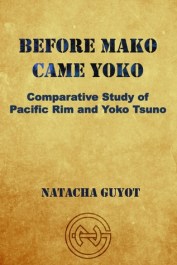
Book Review! “Before Mako Came Yoko: A Comparative Study” by Natacha Guyot


This entry is part of “Natacha Guyot’s Blook Blog Tour!”


.

BeforeMakoCameYokoCover

I don’t usually care much for summer blockbusters, which usually have more explosions than compelling emotions.  However, Pacific Rim is one of those rare “popcorn movies” that I felt gave a layer of depth to its characters.  I confess that I was surprised to see Mako, a female Japanese Jaeger pilot, get as much screen time and character arc as she did!  Women as primary main characters is becoming more prominent, albeit slowly, and there is still a dearth of women of color in such roles.  Pacific Rim provided a step in the right direction, even if it fell short on certain points.  But I was unaware that a long-running 1970s comic book series from Belgium had already allowed a female Asian character to step into the spotlight.  Natacha Guyot’s brief but engaging treatise Before Mako Came Yoko: A Comparative Study Between Pacific Rim and Yoko Tsuno elaborates on how the title character of Yoko Tsuno and Mako of Pacific Rim share many key traits.

The book is divided into three parts that explore these similarities, as well as a few of their short-comings.  The first part, “Women of Color as a Female Lead Character” explores the history of the two characters as they developed through their respective media.  While Yoko has four decades of story to draw on and develop from, Mako only has a single film.  Yet both present strong, well-rounded, engaging characters who aren’t reduced to eye candy, exotic tokens, or inevitable love interests by the presence of male associates.  (However, like Ms. Guyot, I would have preferred Mako as the main character and focus of Pacific Rim, since I found her origins and presentation far more interesting than that of the male lead!)

The second part is “Combat, Science, and Compassion,” which looks at the skill sets Yoko and Mako possess that helps make them real people and helps solidify their importance and relevance to the plots of their respective stories.  Scientific knowledge and martial arts are a shared skill set, although Yoko Tsuno touches on religion and spirituality in a way that has little to no place in Pacific Rim.  A big difference is that Yoko faces danger on a more or less regular basis throughout the comics.  Mako doesn’t have the opportunity to fight her enemies, the alien Kaiju, until well into the film, and even then, only for a short time.  Visually and narratively, Mako and Yoko break the mold in progressive ways.

“Composite Family and Inner Circle” comprises the final section.  Yoko and Mako share many similarities in their creation of a new “family” outside their blood relations.  With so many years of development, Yoko has far outpaced Mako in this area.  This may be a necessity of the medium, but there is hope that future installments of Pacific Rim will expand on Mako’s role in the story and her circle of friends.

Before Mako Came Yoko is an intriguing look into the world of representation for female and minority characters in media. It draws connections between modern cinema and classic comics to show how progressive some of these characters are… and how far we still have to go. Be sure to check out Ms. Guyot’s website for other books and articles discussing similar topics in Star Wars, Farscape, and more!


natachaguyotNatacha Guyot is a French researcher, author and public speaker. She holds two Master’s degrees: Film and Media Studies (Paris III Sorbonne Nouvelle) and Digital Culture and Technology (King’s College London).

Her main fields of interest are Science fiction, Gender Studies, Children Media and Fan Studies. Besides her nonfiction work, she also writes Science Fiction and Fantasy stories.

Natacha’s Publications     |     Twitter     |     Facebook     |     LinkedIn

Contrivance and Coincidence

Click HERE for the Audio Edition!


“But people don’t act like that.” [W. Somerset] Maugham pointed to the grave dangers coiled in that treacherous phrase. Our demand for probability grows more and more stringent. We balk at coincidence and accident. We invariably expect the characters who are presented to act like ourselves. “People don’t act like that?” True enough — MOST people don’t act like that. Your story is not ABOUT most people. The true enemy of your fiction is not improbability but imaginative unbelief.

— Stephen Koch, The Modern Library Writer’s Workshop: A Guide to the Craft of Fiction,  (page 185)

As I’ve been working through my current draft of All’s Fair, there’s a certain element that keeps coming up that I think needs to be addressed:  contrivance and coincidence.

We’ve all see or read stories where characters end up in exactly the right place at exactly the right time.  Or they find what they need to beat the bad guy minutes before facing off in the final fight.  Or they are about to die and rescue arrives just in the nick of time with no explanation of where they were and how they got there so fast.  It’s more blatant in some stories than in others.  When done badly, it can destroy the suspension of disbelief necessary to maintain a story.  No writer wants that to happen to their story.  Events are supposed to be seamless, flawless, inevitable.  We want to present them in the most effective, realistic, and logical manner possible.  We don’t want anything to seem contrived.

Well, I’ve some bad news for you: all stories are contrived.

Continue reading “Contrivance and Coincidence”

Favored Fairytales: Beauty and the Beast

Click HERE for the Audio Edition!


This entry is part of an on-going series discussing my favorite fairytales and their multiple modern re-tellings.  Any entries relating to this topic will be labeled “Favored Fairytales.” 


Have you ever found yourself consuming numerous variations of a single story?  I go through different spurts, often tied to genre, but sometimes a particular kind of story grabs me and won’t let go until it’s sated.  So I wanted to talk about one of my favorite fairytales, one that is probably familiar to most people.

Like most kids, I was raised on Disney films.  Some I always felt lukewarm about, some that used to be favorites no longer appeal to me, even though I can appreciate the talent and artistry that went into making them.  I never liked Sleeping Beauty and I was always ambivalent about Snow White and Cinderella.  Some, like The Lion King and Mulan, have withstood the test of time and remain favorites.  When I was a kid, The Little Mermaid was my favorite, hands down.  But now, as an adult, a different film has risen to the top of the list:  Beauty and the Beast.

Continue reading “Favored Fairytales: Beauty and the Beast”

Long time, no see

Click HERE for the Audio Edition!


Um… hi?

*waves*

Wow.  I… haven’t written an entry in a while.  In fact, I haven’t really posted anything online for at least a month.  No blog entries, no Audio Editions, no #ThrowbackThursdays, no new fanfic chapters… I regret that last one, especially since I’d made a point to say I wouldn’t make my readers wait years for the completion of a fanfic.

But, obviously, I haven’t kept up with much of anything online.  Because reasons:

Continue reading “Long time, no see”

2015 Summer Reading (and Writing) Program from Nerd in the Brain

Click HERE for the Audio Edition!


Hello all!

Sorry, I know I haven’t been keeping up with most of my online writing, but I promise it’s because I’ve been hard at work editing Ravens and Roses.  But I did want to share something fun that I’m doing at the same time:  the Summer Reading (and Writing) Program from Nerd in the Brain.

I only found out about this challenge a few days before it started, but I’ve been enjoying it.  There are 30 reading challenges, 10 writing challenges, and 10 “other” challenges.  I’ve been reading like a madwoman, since now I have added motivation to get through the pile of library books I’ve been hoarding for weeks.  The reading challenges are really easy to write a small summary for, but the writing challenges are (for me) a little harder to tackle.  I didn’t want to just write a little summary of something I wrote, but I also didn’t want to post the entire response to the challenge in that small space.  It could be done… I just didn’t want it to be inconvenient.

So I decided to post my writing responses here on The Cat’s Cradle, as well as a list of the books I read for the reading challenge.  I’ll post a summary and a link for Nerd in the Brain, so I won’t take up all that space, but folk can see what I did if they want to.  So check back throughout the summer to see the results of the challenge.

Here goes!

Continue reading “2015 Summer Reading (and Writing) Program from Nerd in the Brain”

Where Are the Ladies? Female Protagonists in Fantasy

Click HERE for the Audio Edition!


One of my friends mentioned that, when she was a kid, she couldn’t find any female characters she liked or could relate to.  In fact, she became misogynistic herself for a time because the only examples of women were weak, whiny, helpless bimbos.  Not exactly the best role model for a growing girl.

But oddly enough, I don’t remember there being a deficiency in heroines during my childhood years of reading.  But then again, I read fantasy and it seems that fantasy has a higher prevalence of female protagonists (and women in general.)

I’ve heard about several studies that speculate on the lack of female characters in children’s and young adult literature.  Granted, this has been changing over the last few years, especially in teen literature, but I still find that female characters, when they are present, tend to fall into the emotional/romance category.  There are fewer examples of (dare I say it?) “strong” (or rather, “well-rounded”) female characters in children’s fiction.

Since my last entry, “Character Charisma,” was so heavily skewed towards male characters (9 men to 1 woman), I wanted to explore some of my favorite female characters in fantasy novels. Unfortunately, in the video games I’ve played so far, there are very few, if any, female characters who left much of an impression, and even fewer who were the star of the show. The only two that come to mind are the sun goddess Amaterasu (Ammy) from Okami and Aurora from Child of Light. (Both of these are beautiful games with unique designs and gorgeous musical scores, and I highly recommend playing them.) Or maybe I just haven’t played enough games, but either way I’m going to focus on books that I read with interesting, unique, or kick-ass protagonists… who happen to be girls.  (I apologize in advance for any mispronunciations.)


WARNING: THE DESCRIPTIONS BELOW MAY CONTAIN SPOILERS!

Continue reading “Where Are the Ladies? Female Protagonists in Fantasy”

Character Charisma: A Collaboration with R.E. Myles

Click HERE for the Audio Edition!


Readers, you are getting a special treat this week.   Rather than having me ramble aimlessly, you get to have two of us rambling aimlessly!   Yup, this is my first ever writing collaboration.   The awesome co-author this week is my good friend and fellow writer, R.E. Myles.   She suggested exploring why we are drawn to certain characters and types of characters in books and video games.   We decided that the Q&A format with seven questions would be the best way to answer this so you can get a clear idea of what (and who) we like in stories. For the record, both Myles and I read a lot of fantasy, and when we say “video games,” we’re primarily referring to third person roleplaying games. With such similar tastes, there is some overlap in our answers. We apologize to the authors in advance for any mispronunciations.  Enjoy!

Continue reading “Character Charisma: A Collaboration with R.E. Myles”