#BlogHop – Advice for New Writers

Week 4 of the #Blog Hop for #Writers hosted by Ruth Snyder!  This week, the topic is “Advice I’d Give a Newbie Writer.”

It feels a little weird for me to be giving advice.  After all, I’m not a best-selling novelist.  (Yet.)  I haven’t actually published anything.  (Yet.)  In fact, aside from a handful of dubious short stories and some amateur poetry, I haven’t even finished anything.  (Yet.)  That is why I refer to myself as an “author-in-progress.”

I could direct you to hundreds of books written by people far more articulate, interesting, and qualified than I am for advice on writing.  (I’m including a list of my favorite ones at the end of this entry for the curious and masochistic.)  I could parrot the many tried and true sayings that have percolated my brain over the years, like “Have a routine,” or “Write every day,” or “The first draft always sucks; don’t let that discourage you,” or “Everyone has their own way of writing.”  All of which are valid pieces of advice.  There are plenty of bit-sized tidbits floating around on the internet in the form of brightly colored, friendly-looking helpful quotes in fancy fonts, often accompanied by pictures of a pen, paper, books, or tea.  Like this one, for instance:

via Pinterest

So I don’t feel like I’ve put in the hours or had the success that would make me qualified to give out advice.  But there is one thing that I’ve learned that I’d like to share:

Continue reading “#BlogHop – Advice for New Writers”

“What do you protect?” Storytelling Shifts Focus

A few days ago, I was listening to the song “Hail the Hero” by Celtic Thunder, and something in the lyrics struck me:

“Hail the hero, strong and true,
Who fought the fight, and saw it through,
Who swore he ne’er would be a slave
And gave his life our land to save.”

Do you see it?  No?  Look at this line then:

“And gave his life our land to save.”

There’s been a subtle shift in the focus of what is being protected in a story.  It used to be that the hero was trying to save a land, a world, or a people as a whole rather than being devoted to an individual.  They gave everything “for the land.”  Often, rulers were tied to the land in some way, either through mystical means (having a literal bond with the earth) or through responsibility as a prince or princess, a king or queen.

Continue reading ““What do you protect?” Storytelling Shifts Focus”

What Minds Accept

The other day I was going through a stack of books being sent back to the main library.  We rotate our collection periodically and books that have been on the shelf for too long get sent back to be replaced with newer books.  I always flip through ones that catch my eye, even though most of them are romance, mystery, or realistic fiction, and I usually don’t read those genres.

One of the books that caught my attention was Blind Submission by Debra Ginsberg.  Since it’s about reading, writing, and publishing, I looked at the book description.  The heroine is a reader named Angel Robinson who lands a dream job working for a publishing agent.  However, the job is harder than it looks because she’s constantly trying to balance her dragon-like boss’s ego with finding and polishing good book submissions.  The struggle keeps her on her toes.  But things get creepy when Angel receives an anonymous (“blind”) submission and the contents of the manuscript mirror her own life.  As subsequent chapters of the book appear in her inbox, along with intimate revelations of her lie and thinly veiled threats, Angel must play a game of cat-and-mouse that might quickly become deadly.

After I finished reading the front leaf, I wrinkled my nose and said, “Really?  This idea is too flimsy and relies way too much on coincidence to be believable.”

Continue reading “What Minds Accept”

Is Fantasy Becoming Too Dark?

There is a great disturbance in the Force.  Its name is Game of Thrones.

No, this is not another anti-Thrones rant, and no I haven’t watched or read beyond the first season and book of the series.  Really, this isn’t about Game of Thrones.  It’s about a trend in fantasy that I believe has come to a head.

For the first time, adult fantasy has really reached mainstream culture.  Harry Potter paved the way, but that was initially a book series for kids.  The fact that adults liked it too was a phenomenon all its own.  But Game of Thrones never was intended for children, and HBO is definitely geared for a mature adult audience.

There are many things that disturb me about Game of Thrones, but it was really a discussion with a friend that got me thinking about why my reaction to it has ranged from apathetic to negative.  One of the main selling points of Game of Thrones is its uncertainty.  There is a lack of the clear-cut lines between friend and foe, antagonist and protagonist, to the point where you can’t really know who or what you’re rooting for, let alone what will happen next.  Anyone could die at any time.  To the show’s credit, I’ve heard that none of the deaths have been just for their shock value; there are repercussions and the characters have to deal with that.  It’s a tight-woven web of realism and intrigue, something that really should appeal to me.

But it doesn’t.

Why?

Continue reading “Is Fantasy Becoming Too Dark?”

Influential Books: Part 5

This is the fifth and final part of a series of entries discussing various books that deeply influenced my writing and outlook on stories.  You can read the Introduction here, Part 1 here, Part 2 here, Part 3 here, and Part 4 here.  Please note that discussion of these books may contain spoilers.

I thought I’d close out this discussion of influential books with a genre that I don’t usually read:  nonfiction.  It’s only in the last three years or so that I’ve really started delving into nonfiction; before I just passed it by as something that I don’t dealt with for research, not read for fun.  However, I started finding interesting books about internet culture, fandom, introverts, and writing.  So, here I am to talk about three nonfiction books that helped influence me as a person as well as a writer.

Image via dailyom.com

This book saved my life.  I’m only slightly exaggerating when I say that.  I was deep in the grip of depression when my onii-san David let me borrow his copy of Finding Your Own North Star: Claiming the Life You Were Meant to Live by Martha Beck.  I was in pain, confused, and trying desperately to claw my way out of a hole I had only recently realized I was in.  I needed to make sense of what was happening to me, why I was so unhappy, and what to do about it.  Listening to other people doesn’t help me much because I often find it hard to relate to someone else’s thought processes.  But books…a book I can read.  A book I can understand and apply to my own life and experiences.  And Finding You Own North Star helped me do just that.

Continue reading “Influential Books: Part 5”

Influential Books: Part 4

This is the fourth part of a series of entries discussing various books that deeply influenced my writing and outlook on stories.  You can read the Introduction here, Part 1 here, Part 2 here, and Part 3 here.  Please note that discussion of these books may contain spoilers.

The next round of influential books didn’t come until I entered college.  Granted, I found lots of books that I loved between the age of 12 and 18, but truly influential books are much rarer.  In my freshman year, I discovered anime and manga.  Last Exile was the first anime I ever watched (I’m not counting random Pokemon episodes I saw when I was little), and reading manga soon followed.  A six-year obsession with all things Japanese had begun.  During that time, I read and watched so much anime that I needed a list to keep track of them all.  Three series stick out in my mind from that time that remain favorites and powerful influences.

Image via mangahere.com

The first of these was Pet Shop of Horrors by Matsuri Akino.  This 10-volume series is a horror manga, not my usual genre of choice.  It’s both beautiful and eerie, revolving around a pet shop in Chinatown run by the enigmatic, androgynous, and  amoral proprietor known only as “Count D.”  Each volume contains about four stories of various people who come into the pet shop and leave with a pet…under certain conditions.  Like in Gremlins, disobeying D’s instructions as to the care and feeding of their pets often results in calamity.  Sometimes the pets are helpful to their new owners, but most of the time it ends in tragedy.  Weaving through these tales alongside D is Leon Orcot, a detective who is sure that D has something to do with the various mysterious deaths throughout the city, but is unable to come up with any proof.

Continue reading “Influential Books: Part 4”

Influential Books: Part 3

This is the third part of a series of entries discussing various books that deeply influenced my writing and outlook on stories.  You can read the Introduction here, Part 1 here, and Part 2 here.  Please note that discussion of these books may contain spoilers.

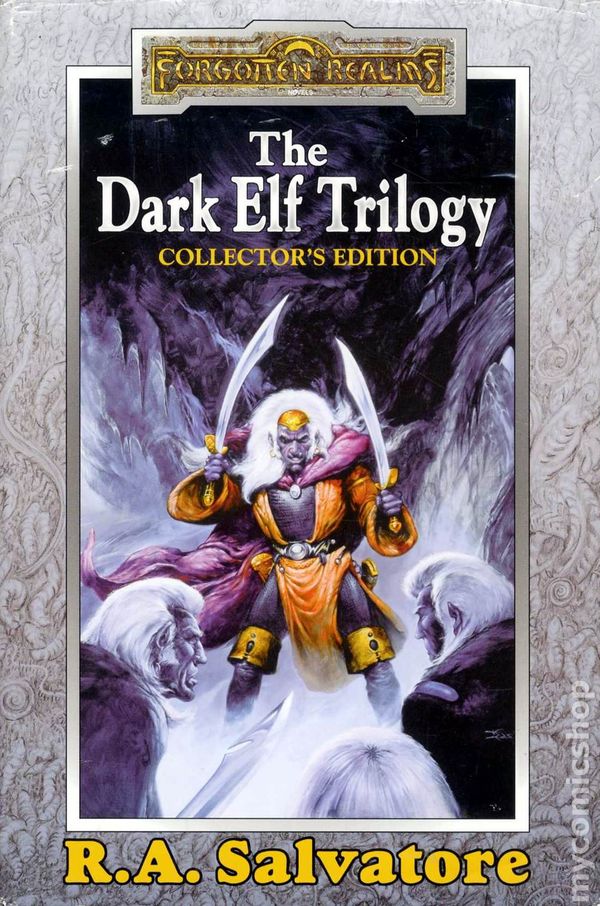
Image via mycomicshop.com

 While writing these “Influential Books” posts, I’ve noticed that most of these books were read between the ages of 8 and 12.  I’m pretty sure I was 11 when I picked up a copy of The Dark Elf Trilogy by R.A. Salvatore.

It was after we’d moved, but we still came back to my hometown in Maryland occasionally.  I think we stopped to get Chinese food or maybe we stopped by the hardware store.  Either way, we had a little extra time, so Mom and Dad let us go into a nearby bookstore.  I had $20 of birthday money in my pocket; a small fortune to me.  I prowled through the shelves, not looking for anything in particular, although I always wanted to buy as many books as possible.  Then I noticed the lurid cover of the February 2000 paperback Collector’s Edition of The Dark Elf Trilogy, which promised to contain the first three books of the Chronicles of Drizzt: Homeland, Exile, and Sojourn.  That got my attention.  I love omnibuses, origin stories, and complete sets, plus I’d never heard of a “dark elf” before, so I bought it.

Continue reading “Influential Books: Part 3”

Influential Books: Part 2

This is the second part of a series of entries discussing various books that deeply influenced my writing and outlook on stories.  You can read the Introduction here and Part 1 here.  Please note that discussion of these books may contain spoilers.  

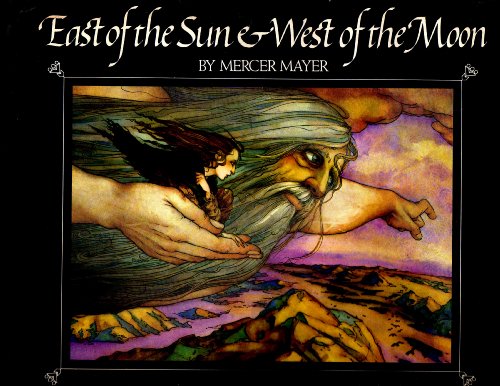
Image via mysummergirl16.blogspot.com

One of the earliest fairy tale books I remember checking out from the library was East of the Sun & West of the Moon written and illustrated by Mercer Mayer.  It’s an old fairy tale and there have been different adaptations of it, most of which involve a polar bear.  (One of my favorite alternate movie adaptations is the Norwegian film The Polar Bear King.)  I cannot tell you how gorgeous the illustrations are, and they’ve stuck with me my whole life.  Even when I forgot the title, I remembered those pictures.  The girl sitting by a pond, a unicorn in the forest, the goat with the corkscrew horns, the giant green fish with scales like mirrors, the prince’s icy prison, and the evil troll queen with a wooden arrow in her heart.  The beauty of these illustrations transported me into a rich, living fantasy world and have influenced my mental imagery of fantasy works ever since.  It also, for a time, made me want to become an illustrator for children’s storybooks.  (Each of the illustrations in Mercer Mayer’s books are done in watercolor.  Watercolor!  His rendition of Beauty and the Beast is equally breath-taking.)  I’d searched on and off for this book for years, but my efforts were frustrated by not remembering anything except those illustrations.  But recently, I stumbled across it by chance on the internet, found the title, and ordered a copy.

Continue reading “Influential Books: Part 2”

Influential Books: Part 1

This is the first part of a series of entries discussing various books that deeply influenced my writing and outlook on stories.  You can read the Introduction here.  Please note that discussion of these books may contain spoilers.  

Image via evercleanbooks.blogspot.com

The earliest fantasy book I remember reading was Dragon’s Milk by Susan Fletcher when I was in second grade.  (The only reason I remember when I read it is because I had to write a book report on it.  Does anyone actually write book reports anymore?)  The book is about the harrowing adventure of a young girl named Kaeldra.  When her sister is struck down by a terrible illness, Kaeldra is told that only dragon’s milk can save her.  But getting milk from a mother dragon is only half the battle.  When the mother dragon is killed, Kaeldra is oath-bound to save the three hatchling dragons from the same fate.  And even though Kaeldra has the ability to speak to dragons, her task won’t be an easy one.

In addition to adding new words to my fantasy vocabulary (notably “ken” and “dracling”), Dragon’s Milk introduced me to several new concepts, such as the power of names, the use of telepathy for communication with nonhumans, and the idea that dragons have an intelligence and view of the world that is very different from humans.  Most little kid stories with dragons and unicorns have the creatures communicating, feeling, thinking, speaking, and seeing the world essentially the same way humans do.  They basically are humans…just with a different drawing attached to them.  Even Bruce Coville’s book Into the Land of the Unicorns, another founding fantasy series for me, had that element in it.  The unicorns communicate telepathically, but their thoughts and world-view really isn’t very different from the human one.  Perhaps that was to make them more understandable, more relatable.

Continue reading “Influential Books: Part 1”

Influential Books: Introduction

But all my life I’ve wanted to be the kid who gets to cross over into the magical kingdom … Because even when I was a child I knew it wasn’t simply escape that lay on the far side of the borders of fairyland.  Instinctively I knew crossing over would mean more than fleeing the constant terror and shame . . . There was a knowledge that ran deeper – an understanding hidden in the marrow of my bones that only I can access – telling me that by crossing over, I’d be coming home.

That’s the reason I’ve yearned so desperately to experience the wonder, the mystery, the beauty of that world beyond the World As It Is.  It’s because I know that somewhere across the border there’s a place for me. A place of safety and strength and learning, where I can become who I’m supposed to be.  I’ve tried forever to be that person here, but whatever I manage to accomplish in the World As It Is only seems to be an echo of what I could be in that other place that lies hidden somewhere beyond the borders.

— page 60 from The Onion Girl by Charles de Lint


Continue reading “Influential Books: Introduction”